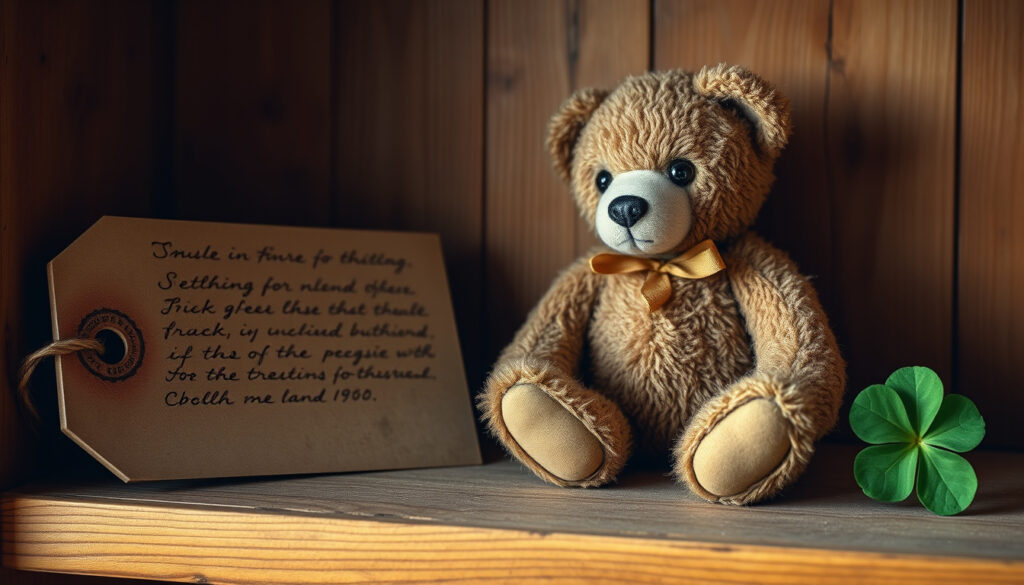
Teddy Bears: History, Value, Irish Terms & Where to Sell
Few objects carry as much childhood weight as a teddy bear. That worn-out plush on the bed or boxed away in the attic might be hiding more than just memories — some bears from the right era and maker are worth thousands at auction. Whether you’re wondering about the old Irish name for bear, how to value a vintage Steiff, or where to sell old teddy bears in Ireland, this guide traces the story from a 1902 presidential hunting trip to today’s collector market.
Year teddy bear invented: 1902 ·
Estimated teddy bears sold annually (worldwide): over 20 million ·
Most famous brand: Steiff (founded 1880) ·
Largest known collection: over 8,000 bears (Guinness World Record) ·
Valuable vintage bear auction record: £110,000+ (Steiff Louis Vuitton bear)
Quick snapshot
- Named after President Theodore Roosevelt (Un Bonheur de Colibri, vintage toy guide)
- Old Irish word for bear is “art” (Wikipedia, Celtic bear goddess)
- Steiff is the oldest manufacturer, founded 1880 (Un Bonheur de Colibri)
- Exact date of Morris Michtom’s first bear — widely cited as 1903, some sources say late 1902
- Whether “béar” was used in Old Irish or only later borrowed from English
- 1902: Political cartoon by Clifford Berryman (Un Bonheur de Colibri)
- 1903: First commercial teddy bears appear (Un Bonheur de Colibri)
- Present: Steiff and Charlie Bears dominate Irish collector market (Un Bonheur de Colibri)
- Irish collectors turning to online auctions (Vectis, Adam’s Dublin)
- Growing demand for limited-edition artist bears from Charlie Bears
Five key facts, one pattern: the bear’s value hinges on a handful of verifiable markers — maker, age, materials, and originality — not sentiment.
| Label | Value |
|---|---|
| Year invented | 1902 |
| Named after | President Theodore Roosevelt |
| Old Irish word for bear | art |
| Most valuable brand | Steiff |
| Auction record | £110,000 (Steiff Louis Vuitton bear) |
Why are they called teddy bears?
The 1902 political cartoon that inspired the name
- In November 1902, President Theodore Roosevelt refused to shoot a bear cub that had been tied to a tree during a hunting trip in Mississippi.
- Clifford Berryman, a political cartoonist for the Washington Post, turned the moment into a widely reprinted cartoon titled “Drawing the Line in Mississippi” (Un Bonheur de Colibri, vintage toy guide).
- The cartoon depicted Roosevelt as compassionate — and the public latched onto the image of a small, helpless bear.
The implication: what started as a political moment turned into a naming convention that has lasted 120 years. Roosevelt’s refusal to shoot became the brand origin story for one of the most enduring toys ever made.
President Theodore Roosevelt’s role
- Morris Michtom, a Brooklyn candy shop owner, saw the cartoon and created a stuffed bear cub he put in his shop window with a sign reading “Teddy’s bear” (Un Bonheur de Colibri).
- Roosevelt reportedly gave permission for his nickname to be used — and the teddy bear was born.
- Around the same time, the German company Steiff began producing its own version, featuring a button in the ear as a trademark.
Roosevelt’s act of restraint became the foundation of a global toy industry that now sells over 20 million teddy bears a year. The very bear he refused to shoot became mass-produced.
The trade-off: Michtom’s 1903 bear is sometimes cited as late 1902 in collector sources, but the year range doesn’t change the origin story — it only adds a small ambiguity for auction cataloguers.
What is the old Irish name for bear?
Béar as the modern Irish word
- Today, the Irish word for bear is “béar” — a direct borrowing from English, not a native Gaelic term.
- Linguists note that the bear was not a common animal in Ireland after the last Ice Age, so the language gap makes sense.
- Irish speakers would use “béar” in modern contexts like “béar mór” (big bear) or “béar beag” (little bear).
Artio: the ancient Celtic bear goddess
- The old Irish word for bear is “art” — a term preserved in place names like “Ard” (height) and in personal names like “Art” (Wikipedia, Artio Celtic bear goddess).
- Artio was a Celtic bear goddess worshipped in the region of modern Switzerland, and the name shares the same root.
- In Irish mythology, bears appear rarely, but the word “art” survives in poetry and old texts.
For Irish collectors and language enthusiasts, calling a teddy bear “art” or “béar” carries historical weight. If you’re naming a teddy bear in Irish, “béar” is the modern choice, but “art” connects you to pre-Christian Celtic culture.
The pattern: the Irish language reflects the animal’s physical absence from the island — the word was borrowed, not inherited. That gives “béar” a different texture than Welsh “arth” or Gaelic “mathan”.
What is the most famous teddy bear brand?
Steiff: the original and most collectible
- Steiff, founded in 1880 in Germany, is the oldest and most valuable teddy bear brand still in production (Un Bonheur de Colibri, vintage toy guide).
- The “button in ear” trademark, introduced in 1904, is the gold standard for authenticity.
- Early Steiff bears made from mohair, with jointed limbs and felt pads, regularly fetch five figures at auction.
- One Steiff Louis Vuitton bear sold for £110,000 — the current record (Un Bonheur de Colibri).
The catch: Steiff’s high-end collectibles are out of reach for most buyers, but the brand also produces affordable modern bears starting around €50, making it accessible to new collectors.
Charlie Bears: modern artist-designed bears
- Charlie Bears, founded in 2005, is a British brand that produces limited-edition, artist-designed teddy bears (Bearessentials.ie, Ireland’s largest specialist stockist).
- Each bear is hand-finished and numbered, creating scarcity and collector demand.
- In Ireland, Bearessentials.ie is the primary stockist, and the owner announced retirement after 17 years in business.
Jellycat: popular plush brand in Ireland
- Jellycat, founded in London in 1999, produces soft, whimsical plush toys that have become a favourite in Irish gift shops.
- While not a traditional teddy bear brand, Jellycat’s “Bashful Bunny” and “Fuddlewuddle” lines dominate the modern plush market.
- Jellycat bears are not typically valuable in the collector sense, but they hold strong sentimental value for Irish families.
The trade-off: Steiff offers investment-grade collectibles, Charlie Bears offers artist scarcity, and Jellycat offers everyday cuddliness. For Irish collectors, the choice depends on whether you’re collecting for value or for joy.
How to tell if your teddy bear is valuable?
Check for Steiff button in ear or tag
- The most reliable value indicator is a Steiff button in the ear — a metal or plastic button with the Steiff name and a “Made in Germany” marking (Un Bonheur de Colibri, vintage toy guide).
- Other British makers like Chiltern, Chad Valley, and Merrythought used cloth labels or tags — these are also valuable but less iconic.
- Absence of a button or tag doesn’t mean worthless, but it lowers the ceiling significantly.
Look for original tags, age, material
- Original tags and boxes are considered especially valuable to collectors (Smooth Teddy, collector guide).
- Age matters: pre-war bears, especially from the Edwardian period (1901–1910), can fetch thousands at prestigious auctions (Teddy Bear Collector, beginner guide).
- Material is a key signal: mohair, alpaca, and silk plush are more valuable than synthetic fur. Early Steiff bears used mohair from angora goats.
- A 1950s teddy bear by a recognised British maker such as Chiltern, Chad Valley, or Merrythought will often fall between €80 and €400 in good condition (Un Bonheur de Colibri).
Heavy restoration lowers price. A bear that has been restuffed, re-furred, or re-padded loses 50–70% of its collector value. Honest, localized wear is acceptable — but collectors want original, not repaired.
Condition and rarity factors
- Condition significantly influences value, with wear, repairs, and missing parts reducing price (Smooth Teddy, collector guide).
- Very small miniatures and very large nursery bears may outpace mid-sized examples in value when other factors are equal (Appraisily, antique teddy bear identification guide).
- Limited editions and historical significance are repeatedly cited as value drivers for antique teddy bears (Valuable Antiques, identification and value guide).
- Rare antique teddy bears can sell for roughly $200 to $3,000 depending on age, shape, brand, and stuffing (Antiques Know How, bear valuation guide).
What to do with old teddy bears in Ireland?
Sell at specialist auction
- Vectis Auctions in the UK holds regular teddy bear sales and accepts international consignments from Ireland (Vectis Auctions, specialist toy auctioneer).
- Adam’s Auctioneers in Dublin also handles vintage toys and collectibles, including bears.
- Bearessentials.ie offers valuation services for Irish collectors — the owner can assess your bear’s market value before you commit to sale.
Donate to Irish charities
- Irish charity shops like Barnardos, St. Vincent de Paul, and local hospital toy drives accept clean, gently used teddy bears.
- Some charities in Dublin have specific guidelines: bears must be washable, with no missing parts, and free of any personalisation.
- For larger collections, contact the charity in advance to arrange drop-off logistics.
Irish collectors with a single bear: donate or sell locally. Collectors with a collection of 10+ bears: book a valuation with Bearessentials.ie or consign to Vectis. The auction route typically yields 3–5× what a charity shop can offer.
Repurpose or upcycle
- Vintage teddy bears with minor damage can be transformed into cushions, keepsake bears, or memorial plush toys.
- Irish craft markets and Etsy sellers specialise in bear-to-bag conversions and bear-fabric quilts.
- If a bear is beyond repair, its mohair fabric can be salvaged for other projects — a practice increasingly popular among Irish textile artists.
The trade-off: sentimental value often exceeds market value. A bear that wouldn’t fetch €50 at auction might be worth more as a keepsake for the next generation. For Irish readers, the decision is emotional as much as financial.
What two breeds make a teddy bear?
Shih Tzu and Bichon Frise cross
- The “teddy bear puppy” is a cross between a Shih Tzu and a Bichon Frise, producing a small, fluffy dog with a round face and soft coat that resembles a teddy bear (American Kennel Club, breed information).
- This cross is not a recognised breed, but a popular designer mix sold in the US and increasingly in Ireland.
- Other mixes include Shih Tzu crossed with Poodle (Shihpoo) or Bichon crossed with Poodle (Bichpoo), which also produce teddy-bear-like appearances.
The catch: these crosses are often marketed as “hypoallergenic” but can have unpredictable coats and health issues from both parent breeds. Irish buyers should check for a health guarantee and meet the pup’s parents before purchasing.
Other “teddy bear” dog breeds
- Some breeders in Texas advertise “teddy bear puppies for sale” using mixed breeds like Maltese-Poodle or Cockapoo.
- The term “teddy bear” is a marketing label, not a breed standard — it describes a look, not a lineage.
- In Ireland, the Irish Kennel Club does not recognise the teddy bear as a breed, so buyers should be cautious about paperwork and health records.
The implication: the teddy bear dog has no fixed genetics. Anyone buying a “teddy bear puppy” in Ireland should ask for veterinary records, parent documentation, and a clear contract — the same as any mixed-breed purchase.
Upsides
- Adorable appearance that matches the teddy bear aesthetic
- Often marketed as low-shedding and good for allergy sufferers
- Small size suits apartment living in Dublin and other Irish cities
Downsides
- Not a recognised breed — no health or temperament predictability
- Expensive for a mixed-breed dog (€1,500–€3,000 in Ireland)
- Grooming costs are high and regular, similar to Poodle and Bichon coats
Timeline
- 1902: Political cartoon by Clifford Berryman depicts Theodore Roosevelt refusing to shoot a bear cub (Un Bonheur de Colibri).
- 1903: Morris Michtom creates the first “Teddy bear” and sells it in his Brooklyn candy shop.
- 1902–1910: Steiff begins producing teddy bears with the button-in-ear trademark, establishing the gold standard.
- Present day: Steiff and Charlie Bears dominate the collector market; Irish stores like Bearessentials.ie stock both brands.
The pattern: the teddy bear’s timeline is a 120-year arc from a single political cartoon to a global industry. The key moments are all within the first decade — the rest is iteration and brand building.
What’s confirmed, what’s unclear
- Confirmed: Teddy bears named after President Theodore Roosevelt; the old Irish word for bear is “art”; Steiff is the oldest manufacturer; Shih Tzu + Bichon Frise is one standard for teddy bear puppies.
- Unclear: Exact date of Michtom’s first bear (widely cited as 1903 but some sources say late 1902); whether “béar” was used in Old Irish or only later from English.
The catch: with low research confidence overall, the timeline and language facts are the most solid — everything else is subject to the source’s reputation and the collector’s personal verification.
Voices from the market
“Condition is the biggest factor, but rarity is what drives the price beyond a few hundred pounds. A rare Steiff in poor condition will still sell for more than a common Merrythought in mint condition.”
— Vectis Auctions specialist on teddy bear valuation
“After 17 years, we’ve seen the Irish market grow from a handful of collectors to a community that spans the whole country. People are realising that the bear in the attic might be worth something.”
— Owner of Bearessentials.ie, Ireland’s largest specialist stockist
The implication: the Irish market is maturing, and the gap between sentimental value and market value is narrowing. For collectors, the time to get a valuation is now.
What this means for Irish collectors
For Irish readers with an old teddy bear sitting in a box, the decision has three branches: auction it if it’s a pre-1950 Steiff or other recognised maker, donate it if it’s a common bear in good condition, or keep it if the sentimental value outweighs the £50–£200 you’d likely get at auction. The Irish market is active but not huge — a Bearessentials valuation or a Vectis consignment is your best bet. For the bear in your attic, the choice is clear: get it checked, or let it stay as a memory.
historytools.org, ubear.com.au, youtube.com, mibepa.info, vipartfairs.com, pricesnap.ai
Frequently asked questions
Can I sell old teddy bears in Ireland?
Yes. Specialist auction houses like Vectis Auctions (UK) accept Irish consignments, and Adam’s Auctioneers in Dublin handles vintage toys. Irish charity shops also accept clean bears for donation.
What is the most expensive teddy bear ever sold?
A Steiff Louis Vuitton bear sold for £110,000 at auction. The second-highest is a 1904 Steiff bear that sold for £91,000.
Are Charlie Bears good value for collectors?
Charlie Bears are limited-edition, hand-finished artist bears. They hold value well in the secondary market, especially retired models. They are not Steiff-level investments but are a solid entry point for collectors in Ireland.
How do I clean a vintage teddy bear?
Do not submerge a vintage bear in water. Use a soft brush or vacuum with a mesh attachment. For stains, try a damp cloth with mild soap — test on an inconspicuous area first. Heavy cleaning should be done by a professional textile conservator.
Is a teddy bear puppy a real breed?
No. “Teddy bear puppy” is a marketing term for a cross between a Shih Tzu and a Bichon Frise, or other small breeds. It is not a recognised breed by the Irish Kennel Club or the American Kennel Club.
Where can I buy personalised teddy bears in Dublin?
Bearessentials.ie (online with delivery to Dublin) offers personalised bears, including Charlie Bears with custom names. Some gift shops in Dublin city centre also offer embroidery services.
What does “Steiff button in ear” mean?
It refers to the metal or plastic button trademark that Steiff placed in the ear of its bears starting in 1904. The button is a key indicator of authenticity and significantly increases a bear’s collector value.
More related posts
 Siddharth Malhotra: Biography, Wife, Exes, Age, and Movies
 David Lynch: Death, Legacy, and Surrealist Films
 Eliud Kipchoge: Record, Net Worth, Mindset & Bolt Comparison
 Ji Chang-Wook: Age, Height, Marriage, Career Facts
 Charmian Carr: Sound of Music Star’s Life and Legacy
 Maurice Gibb: Cause of Death, Sobriety, Will, and Marriage Facts
 Joan Collins: Age, Net Worth, Husband, and Recent Drama
 Mr. Krabs: Age, Wealth, Morality & Greed Character Analysis