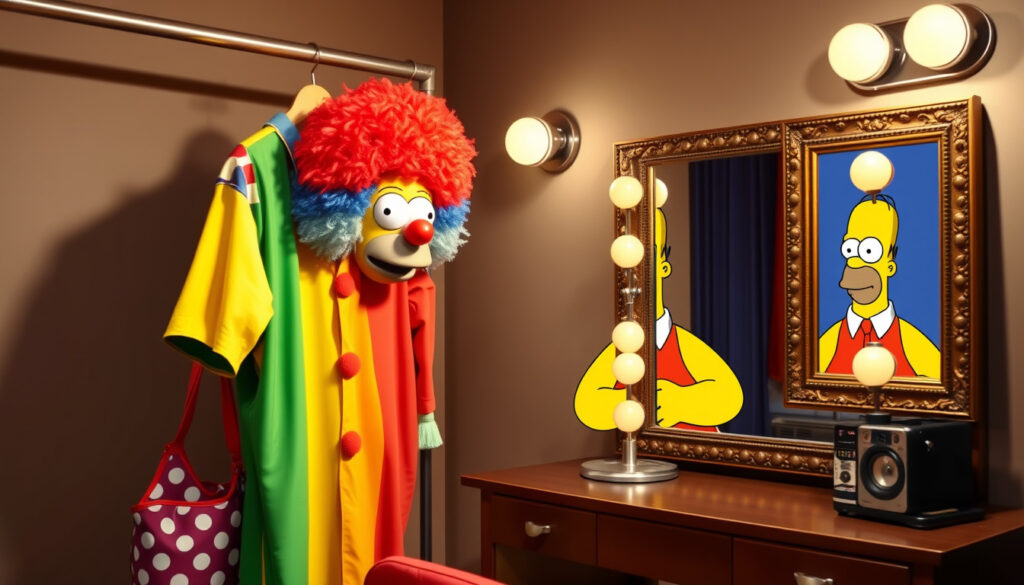
Krusty Clown: Real Name, Parody, and Why He Looks Like Homer
Anyone who has watched The Simpsons knows the feeling: you’re laughing at Krusty the Clown’s antics, but underneath the greasepaint there’s a cynicism that feels all too real. His full name, Herschel Shmoikel Pinchas Yerucham Krustofsky, isn’t just a joke — it’s a window into how the show layers parody, identity, and showbiz failure. This article breaks down Krusty’s real name, why he looks like Homer, who he parodies, and whether he’s actually a good or bad character.
Full name: Herschel Shmoikel Pinchas Yerucham Krustofsky (Wikipedia) ·
First appearance: 1990 episode ‘The Krusty the Clown Show’ (Wikipedia) ·
Voice actor: Dan Castellaneta (YouTube interview) ·
Occupation: Television clown (Simpsons Wiki) ·
Personality: Cynical, greedy, occasionally kind (Simpsons Wiki)
Quick snapshot
- Krusty’s real name is Herschel Shmoikel Pinchas Yerucham Krustofsky (Wikipedia)
- He is voiced by Dan Castellaneta (YouTube)
- First appeared in 1990 (Simpsons Wiki)
- Whether the early ‘Krusty is Homer’ theory was ever definitively canonical (Wikipedia)
- Exact real-life inspiration for Krusty’s specific mannerisms (CBR)
- First appearance: 1990 (Wikipedia)
- Episode ‘Homie the Clown’ aired in 1995 (Wikipedia)
- Krusty continues to appear in new Simpsons episodes, with no sign of retirement (Simpsons Wiki)
Six key facts about Krusty, one pattern: his public persona is a deliberate mask that hides a complicated, often tragic backstory.
| Label | Value |
|---|---|
| Full name | Herschel Shmoikel Pinchas Yerucham Krustofsky (Wikipedia) |
| First appearance | The Krusty the Clown Show (1990) (Simpsons Wiki) |
| Voice actor | Dan Castellaneta (YouTube) |
| Occupation | Television clown (Simpsons Wiki) |
| Ethnicity | Jewish (Ashkenazi) (Wikipedia) |
| Catchphrase | Hey, hey! (Wikipedia) |
What is Krusty the Clown’s name?
Real name and stage name
- Krusty’s canonical full name is Herschel Shmoikel Pinchas Yerucham Krustofsky, as recorded on Wikipedia.
- His stage name is simply Krusty the Clown, a persona completely separate from his birth identity (Simpsons Wiki).
The ridiculously long name is actually a pointed satire of entertainers who hide their roots behind a shiny stage name. Krusty’s Jewish heritage, emphasized by the name, contrasts with the neutral, commercial clown image.
How he got the name Krusty
The character’s surname “Krustofsky” was pitched by writer Al Jean. The name gag functions as a parody of stage names that separate public persona from private identity (CBR).
Origins of the character
Krusty first appeared in the 1990 episode “The Krusty the Clown Show” (Wikipedia). Initially, the character was designed to resemble Homer Simpson, a choice that led to years of fan confusion (CBR).
The implication: The name gag is not just a joke but a deliberate storytelling device that foregrounds the character’s core conflict between public and private identity.
Is Krusty the Clown just Homer?
The original Homer theory
Early in the series, many viewers believed Krusty was Homer Simpson in disguise — a theory that was later retconned. The episode “Homie the Clown” (1995) even played with the idea, showing Homer impersonating Krusty (Wikipedia).
Why they look alike
The physical resemblance is not a plot point but an animation shortcut: the same character model was reused (CBR). The show’s creators have acknowledged the resemblance as a running joke (Wikipedia).
Key differences between Krusty and Homer
Homer is a family man who works at a nuclear plant; Krusty is a cynical, womanizing entertainer who chain-smokes and gambles. Their personalities and life choices are completely different (Simpsons Wiki).
What this means: The visual similarity is an intentional layer of parody that the series refuses to resolve, keeping the gag alive without damaging canon.
Who is Krusty the Clown a parody of?
Real-life inspirations
Krusty is a parody of Bozo the Clown and other television clowns like Rusty Nails (Wikipedia). The character’s Jewish background reflects the real-life heritage of many early TV clowns (CBR).
Satirical elements
Krusty satirizes the commercialization and cynicism of children’s entertainment (CBR). He is deliberately written as a “terrible clown” to critique the entertainment industry (Simpsons Wiki).
Cultural commentary
Beyond clowning, Krusty embodies the burnout of a celebrity who has sold out so completely that he’s lost touch with any genuine joy (Simpsons Wiki).
Krusty isn’t just a funny clown — he’s a satirical mirror held up to the entire children’s entertainment industry, showing how profit and cynicism can hollow out even the simplest art form.
The pattern: Each layer of Krusty’s parody—from his name to his behavior—reinforces the show’s critique of how capitalism drains authenticity from performance.
Why does Krusty look so much like Homer?
Animation similarities
Krusty’s design was intentionally made to resemble Homer Simpson due to shared animation models (CBR).
Behind-the-scenes explanation
The initial idea that Krusty was Homer’s alter ego was abandoned, but the physical resemblance remained as a visual joke (Wikipedia).
Fan theories and canon
Fans continue to debate the connection, but the show’s writers have consistently treated them as separate characters (The Simpsons Archive).
Is Krusty the Clown good or bad?
Krusty’s flaws
Krusty is portrayed as greedy, selfish, and often cruel for profit. He exploits children, sells out his sponsors, and treats his staff poorly (Simpsons Wiki).
Moments of redemption
He occasionally shows genuine kindness, such as helping Bart Simpson or reconciling with his rabbi father (Wikipedia).
The moral ambiguity of the character
The character is deliberately written as a “terrible clown” to critique the entertainment industry (CBR).
Upsides
- Occasional genuine kindness (e.g., helping Bart)
- Provides entertaining television for Springfield’s children
- Represents a satirical critique of corporate entertainment
Downsides
- Greedy and exploitative of fans
- Cynical and often cruel for profit
- Addiction-ridden and unreliable
The catch: His redemption moments are rare enough to highlight the system that created him, not to excuse it.
What’s Confirmed and What’s Unclear
Confirmed facts
- Krusty’s real name is Herschel Krustofsky (Wikipedia)
- He is voiced by Dan Castellaneta (YouTube)
- The character was initially designed to resemble Homer Simpson (CBR)
What’s unclear
- Whether the ‘Krusty is Homer’ theory was ever definitively canonical (Wikipedia)
- Exact real-life inspiration for Krusty’s specific mannerisms (CBR)
- Whether Krusty is a direct parody of a specific Bozo actor or a composite (Wikipedia)
What this means: The line between confirmed and speculative is thin, reflecting how the show deliberately blurs fact and parody.
Quotes on Krusty’s Satirical Power
Krusty is a satire of the commercialized, cynical children’s entertainer. His deliberate incompetence is not a flaw — it’s the whole point.
— CBR (tier2 entertainment analysis)
In the episode ‘Homie the Clown’, Homer’s improvisation ‘my real name is Joe Valachi’ highlights how easily clown identities can be swapped — a contrast to Krusty’s fixed stage persona.
For fans of The Simpsons, the takeaway is clear: Krusty’s deliberate incompetence is not a flaw but a pointed critique of the entertainment industry, and appreciating that makes the show even richer. The character’s enduring appeal lies in his refusal to be a simple hero or villain — he’s a mirror of the compromises that come with fame.
simpsonswiki.com, fr.wikipedia.org, simple.wikipedia.org, it.wikipedia.org, academickids.com, en.namu.wiki, youtube.com
Frequently asked questions
What ethnicity is Krusty the Clown?
Krusty is Jewish (Ashkenazi), as established in several episodes (Wikipedia).
What does Krusty the Clown say as his catchphrase?
His catchphrase is “Hey, hey!” (Wikipedia).
How tall is Krusty the Clown?
Krusty’s height is not explicitly stated in canon, but he appears to be about the same height as Homer Simpson.
Does Krusty the Clown have a family?
Yes, his father is Rabbi Hyman Krustofsky, and he has a daughter named Sophie (Wikipedia).
Is Krusty the Clown based on a real person?
Krusty is primarily a parody of Bozo the Clown and other TV clowns (Wikipedia).
What is Krusty’s doll called?
Krusty merchandise includes a talking doll, often simply called the Krusty doll (Simpsons Wiki).
Does Krusty the Clown ever get cancelled?
In the episode “Krusty Gets Kancelled,” Krusty’s show is cancelled, but he later returns to television (Wikipedia).
Why does Krusty the Clown wear makeup?
Clown makeup is essential to his stage persona, creating a clear separation between his public and private identities (CBR).
Related reading: Mr. Krabs: Age, Wealth, Morality & Greed Character Analysis · Sacha Baron Cohen: divorce, accusations, and ethnicity
More related posts
 Lily Tomlin: Biography, Health, Family, and Career Facts
 Dustin Martin Retirement, Net Worth, and Ethnicity
 Val Kilmer Death: Cause, Final Days, and Legacy Explained
 Charmian Carr: Sound of Music Star’s Life and Legacy
 Sam Campbell: Biography, Comedy Style & Tour Details
 Antonio Brown: Charges, Net Worth & Career Timeline
 Olga Kurylenko: Biography, Movies, Net Worth & Personal Life
 Cast of the Summer I Turned Pretty – Full Actors and Roles Guide