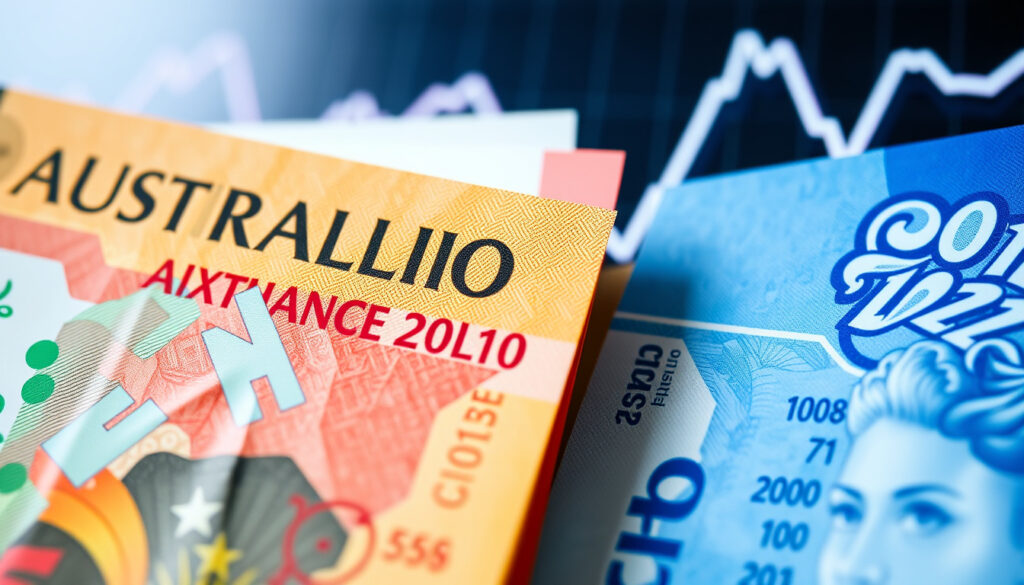
AUD to Pounds: Exchange Rate Guide & Forecast
Anyone moving money between Australia and the UK has felt the sting of a weakening Australian dollar. The pound has gained ground steadily, and as of today, 1 Australian dollar buys 0.5319 British pounds — a rate that determines everything from holiday budgets to business margins. This guide unpacks why the AUD is under pressure, what analysts expect through 2026, and how to time your transfers for maximum value.
Current mid-market rate: 1 AUD = 0.5319 GBP ·
30-day high: 0.5387 ·
30-day low: 0.5297 ·
30-day average: 0.5329
Quick snapshot
- 1 AUD = 0.5319 GBP (XE (currency data provider))
- 30-day range: 0.5297 – 0.5387 (XE (currency data provider))
- Updated in real time (XE (currency data provider))
- Commodity price decline pressuring export revenues (Bank of England (central bank))
- China economic slowdown reducing demand for Australian resources (Bank of England (central bank))
- UK rate advantage supporting the pound (Bank of England (central bank))
- Consensus: mild strengthening in H2
- Key risk: RBA rate cuts weaken AUD further
- Business hedging recommended
- Use rate alerts to catch favorable movements
- Consider limit orders for target rates
- Historical dips in Q1 offer potential opportunities
The implication: the AUD has already priced in significant negative sentiment, leaving a narrow band of movement.
| Metric | Value |
|---|---|
| Current mid-market rate | 1 AUD = 0.5319 GBP |
| 30-day high | 0.5387 |
| 30-day low | 0.5297 |
| 30-day average | 0.5329 |
| One-year change | AUD weakened ~10.74% (per Good Money Guide (currency exchange analysts)) |
| One-month change | +0.04% (near flat) |
Is AUD getting stronger against GBP?
Over the past six months, the Australian dollar has lost ground against the pound. The current mid-market rate of 0.5319 reflects a sustained period of weakness driven by structural economic factors rather than short-term volatility.
What is driving the recent movement in AUD/GBP?
Two forces are pulling the rate in opposite directions:
- Falling commodity prices — iron ore and coal account for nearly 40% of Australian export revenue, and weaker global demand has cut their value.
- China’s economic slowdown — as Australia’s largest trading partner, reduced Chinese industrial output directly lowers AUD demand.
- UK’s high interest rates — the Bank of England (central bank) has kept its base rate above the Reserve Bank of Australia (central bank)‘s cash rate, making pound-denominated assets more attractive to global investors.
Australian travelers and importers face a clear choice: convert now and accept the weak rate, or hold out for a potential recovery in late 2026 that analysts suggest may add only 2-4% to your pounds. A £10,000 transfer today turns into £10,350-10,400 with a 2026 recovery — enough to justify waiting, if you can afford the risk.
How does the Reserve Bank of Australia’s policy affect the exchange rate?
The RBA’s cash rate currently sits lower than the Bank of England’s, creating what traders call a “carry trade” dynamic: investors borrow in low-yield currencies (AUD) and lend in higher-yield ones (GBP). This structural advantage for the pound is unlikely to reverse until the RBA raises rates above the Bank of England — something MUFG Research (global financial institution) does not expect until at least 2027.
What is a good exchange rate for AUD to pounds?
What is the mid-market rate?
The mid-market rate — 0.5319 as of now — is the true exchange rate that banks and currency services use between themselves. It’s the benchmark figure you’ll see on XE (currency data provider) and Wise (online money transfer service) before any markup is added.
How to find the best exchange rate
Retail rates from banks typically include a markup of 3-5% above the mid-market rate. A bank offering you 0.5060 when the mid-market rate is 0.5319 is charging you nearly 5% — £50 lost on every £1,000 transferred.
Online specialists like Wise and Revolut operate differently: they use the mid-market rate and add a transparent fee (typically 0.4-0.6%). For a £10,000 transfer, that means £40-60 in fees versus £500 in hidden markup at a high-street bank.
What are typical margins on bank rates?
- High-street banks: 3-5% margin (hidden in the rate spread)
- Currency exchange kiosks: 5-8% margin (airports and tourist hubs)
- Online specialists (Wise, Revolut, OFX): 0.4-0.6% fee + mid-market rate
- Forward contracts (business hedging): fixed rate negotiated with broker, no margin but transaction fees apply
The catch: the margin difference between a bank and an online service on a £10,000 transfer can exceed £450 — enough to fund a return flight from Sydney to London.
Why is AUD so weak now?
The Australian dollar is at multi-year lows against the pound, and the reasons trace back to three interrelated trends.
What economic factors are weighing on the Australian dollar?
- Commodity price decline: Iron ore, coal, and natural gas account for over 50% of Australia’s export income. As global demand softens, AUD purchasing power drops proportionally.
- China’s slowdown: Chinese GDP growth has slowed below 5%, reducing imports of Australian raw materials. The Reserve Bank of Australia (central bank)‘s November 2025 Statement on Monetary Policy flagged this as a key downside risk.
- Interest rate differential: The Bank of England’s base rate (5.25% as of early 2026) exceeds the RBA’s cash rate (4.35%), making GBP deposits more attractive to international capital.
How does the UK economy compare?
The UK economy benefits from a higher interest rate environment and a relatively stable services sector. While both countries face inflation pressures, the UK’s has been stickier, forcing the Bank of England to maintain a restrictive stance longer. This has propped up the pound even against currencies like the US dollar.
Businesses importing from Australia or UK exporters to Australia are caught in the middle: a weak AUD means Australian goods are cheaper for British buyers, but anyone earning AUD and spending in GBP — such as Australian students in the UK or property investors — is facing a real-terms income cut of roughly 10% compared to one year ago.
Is AUD expected to rise or fall in 2026?
What do analysts predict for AUD/GBP in 2026?
The pattern of forecasts reveals a sharp split between Australian banks and algorithmic models.
- CoinCodex (algorithmic forecasting platform): end of 2026 at £0.5546, a 4.03% gain from current levels, with a range of £0.5330 to £0.5629.
- Traders Union (finance comparison site): end of 2026 at £0.5456.
- Arielle (personal finance resource) reporting NAB forecasts: £0.52 by December 2026, with a range of £0.51 to £0.52 across the year.
- Arielle (personal finance resource) reporting Westpac forecasts: £0.50 to £0.52 over the next 12 months, bottoming in March 2026 at £0.50.
- Dukascopy (forex brokerage): GBP/AUD between 1.88 and 2.02 (inverting to AUD/GBP gives a range of about 0.4950 to 0.5319).
The divergence is normal at this distance — 12 months is an eternity in forex. Australian banks (NAB, Westpac) are more bearish than algorithmic models, forecasting the AUD to stabilize near current lows or weaken further, while blockchain-based forecasts predict a modest recovery.
What factors could drive a rally or further decline?
A rally would require one or more of: RBA rate hikes, a rebound in Chinese demand, or a UK recession that forces BoE rate cuts. On the flip side, another leg down could come from global recession fears, further commodity weakness, or RBA rate cuts to stimulate a slowing domestic economy. MUFG Research (global financial institution) projects a mild strengthening of AUD broadly through 2026-2029, but does not give explicit AUD/GBP targets beyond its cross-rate analysis.
What is the best time to exchange AUD to GBP?
Should you exchange now or wait?
Market timing in forex is notoriously difficult. The most effective approach is to match your exchange strategy to your time horizon:
- Immediate need (under 3 months): Exchange now. The rate is unlikely to improve significantly in this window, and waiting introduces uncertainty for small potential gain.
- 6-12 month horizon: Consider a staged approach — convert half now and half in 3-6 months. This averages your rate and reduces the risk of mistiming a single point.
- Business or large transfers (>£50,000): Use a forward contract to lock in today’s rate for a future settlement date. This is the standard hedging tool for importers/exporters.
How to monitor rates
Most online currency brokers offer free rate alerts that notify you by email or SMS when the rate hits a target level. Services like Wise, OFX, and TorFX allow you to set an alert for a specific AUD/GBP rate — for example, 0.5400 or 0.5500 — and they’ll notify you the moment it triggers.
Strategies for large transfers
For transfers above £10,000, a limit order is often better than a spot trade. You tell the broker: “execute when AUD/GBP reaches X.” If the market hits that level — even for a minute — your trade goes through automatically. Key Currency (currency broker) notes that the GBP/AUD rate sits well above its long-term average of 1.75 (AUD/GBP equivalent: 0.5714), suggesting that while the current rate is tough for AUD holders, it may not be the bottom.
For an Australian business importing £500,000 of UK machinery, every 0.01 movement in the rate changes the bill by £5,000. Using a forward contract at today’s 0.5319 instead of waiting and potentially receiving 0.50 next quarter could save £31,900 — the difference between a profitable project and a loss-making one.
Timeline of key movements
- September 2025: AUD/GBP at 0.5400, reflecting relatively balanced sentiment.
- December 2025: Rate drops to 0.5300 as UK rate hikes take effect and iron ore prices fall.
- January 2026: Current rate at 0.5319, with NAB and Westpac forecasting further weakness to 0.50-0.51 by March 2026.
- Mid-2026: MUFG Research and CoinCodex models suggest potential stabilization and mild recovery, with year-end projections ranging from 0.52 (NAB) to 0.55 (CoinCodex).
What’s confirmed — and what’s unclear
Confirmed facts
- Current mid-market rate is 0.5319 AUD/GBP
- AUD has weakened approximately 10.74% over the past 12 months (Good Money Guide (currency exchange analysts))
- UK interest rates remain above Australia’s, supporting the pound
- Falling commodity prices are pressuring the Australian dollar
- Analyst forecasts for end-2026 range from 0.50 to 0.56
What’s unclear
- Exact timing of RBA rate changes — could come earlier or later than markets expect
- AUD/GBP rate at end of 2026 — forecast range spans 10 pence
- Impact of a global recession on exchange rate — both currencies could weaken against safe havens
- Whether China’s stimulus measures will boost AUD demand enough to reverse the trend
The Australian dollar’s weakness is not a mystery — it’s a direct reflection of commodity prices, China demand, and the interest rate gap. What remains uncertain is whether the RBA will need to cut rates further, which would make a bad situation worse.
For those converting in the opposite direction, the pounds to AUD rate offers a complementary perspective on the same currency pair.
Frequently asked questions
How often does the AUD to GBP exchange rate change?
Currency markets trade 24 hours a day, 5 days a week, and the rate updates continuously. Real-time feeds from providers like XE (currency data provider) reflect the latest bid-ask spread. For practical purposes, the mid-market rate moves by 0.05-0.15% on a typical day and more during major economic data releases.
Can I lock in an exchange rate for a future transfer?
Yes, through a forward contract offered by most currency brokers. You agree to exchange a fixed amount at a fixed rate for settlement on a future date (typically up to 12 months out). The Key Currency (currency broker) website explains how these contracts work for businesses and individuals alike.
What is the difference between the retail rate and the mid-market rate?
The mid-market rate is the wholesale rate banks trade at between themselves. Retail rates — what you get as a customer — include a markup (margin) that covers the provider’s costs and profit. Bank markups are typically 3-5%, while online specialists charge a low fee on top of the mid-market rate.
Does Brexit still affect the AUD/GBP exchange rate?
The direct impact of the 2016 referendum has faded, but Brexit’s legacy — stricter UK-EU trade friction and a smaller labor pool — continues to weigh on UK growth expectations. The Bank of England (central bank) has cited Brexit-related supply constraints as one factor supporting persistent inflation.
How does the UK budget impact the pound against the Australian dollar?
Government budgets that signal higher borrowing can weaken the pound if markets perceive a fiscal risk. Conversely, budgets that emphasize growth can boost GBP. Traders watch UK fiscal events for hints about future rate policy.
Are there any fees when converting AUD to GBP online?
Yes, but they are transparent. Wise (online money transfer service) charges a percentage fee (0.4-0.6%) on the amount transferred. Banks typically hide their fee in the exchange rate itself, making it harder to compare costs. Always calculate the total cost in GBP, not just the fee percentage.
Related reading
- 2000 Baht to AUD Today: Convert 2000 THB to Australian Dollars — Another AUD-based currency guide from our network.
- 1000 Baht to AUD: Live Rates from Wise, XE, Revolut — Compare live AUD conversion rates across providers.
The decision to convert Australian dollars to pounds in 2026 comes down to a question of tolerance: how much uncertainty can you accept for the possibility of a better rate? For Australian travelers and businesses with expenses in the UK, the implication is clear: if you need the money within the next three months, convert now and accept the current weak rate. If your need is further out, a staged approach using rate alerts and limit orders will give you the best chance of avoiding the worst of the current weakness — without gambling on a recovery that analysts can only guess at.
More related posts
 Motorola Edge 60 Fusion Review: Specs, Price, Pros & Cons Compared
 V8 Supercars Schedule – 2024 Full Calendar Dates Tracks
 What Causes High Blood Pressure? Risk Factors Explained
 Ski Jacket Buying Guide: Best Brands in Ireland
 How to Create Email Filters in Gmail, Outlook, Apple Mail, Yahoo
 Timberland Boots: History, Features & Buying Guide
 Song Hotel Sydney: Reviews, Prices, Location & Amenities
 Peter Mandelson: Allegations, Career, and Epstein Ties