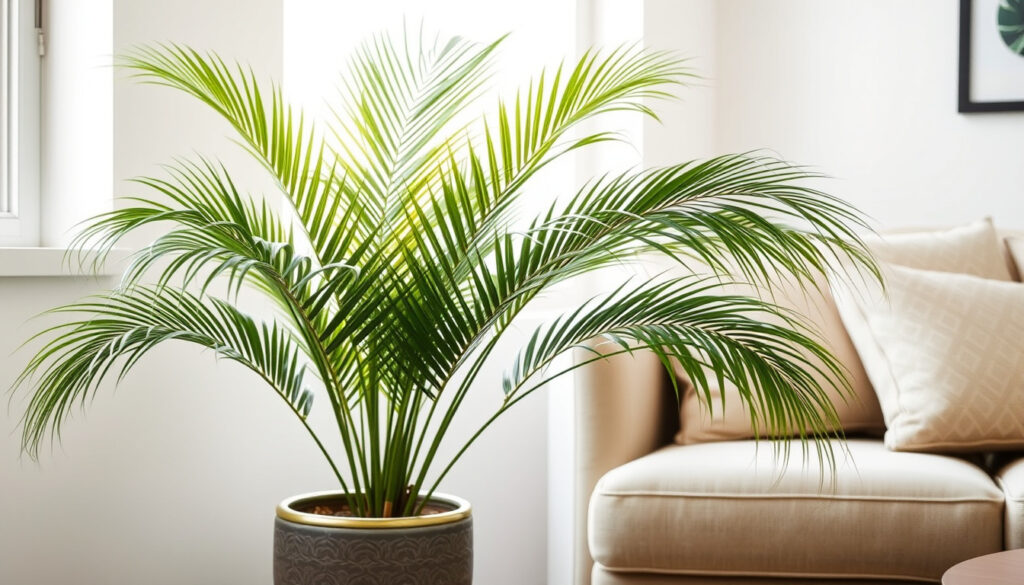
Kentia Palm Care Guide: How to Grow Howea Forsteriana Indoors
There’s a quiet confidence about a Kentia palm that explains why it has been a fixture in elegant interiors for more than a century — it does not demand much, yet it transforms a room. Its graceful, arching fronds bring a soft architectural presence to corners that get little direct light, making it one of the few large indoor plants that won’t punish you for a north-facing window.
Native to: Lord Howe Island, Australia ·
Indoor height: Up to 10–15 feet (3–4.5 m) ·
Light requirement: Low to bright indirect light ·
Pet-friendly: Yes, non-toxic to cats and dogs ·
Lifespan: 50+ years with proper care ·
Typical price range: $50–$200 depending on size
Quick snapshot
- Endemic to Lord Howe Island, Australia (Wikipedia)
- Non-toxic to cats and dogs (Cat Safe Plants)
- Slow-growing; takes years to reach saleable size (Patch Plants) (Wikipedia)
- Exact watering frequency varies by home environment (Healthy Houseplants)
- Air-purification claims lack real-home validation (Healthy Houseplants)
- Long-term outdoor survival in marginal USDA zones (Guide to Houseplants)
- Lifespan of 50+ years indoors (Guide to Houseplants)
- Water every 7–10 days in active growth (Patch Plants)
- Reduce watering in winter; let top half of soil dry (Guide to Houseplants) (Patch Plants)
- Fertilize monthly spring through summer (The Stem)
- Check soil moisture before every watering (Quirky Plants)
- Mist leaves in dry winter air to prevent spider mites (Quirky Plants) (Quirky Plants)
- Repot only when roots fill current pot (Plant Drop)
Seven key facts about the Kentia palm, one pattern: its reputation as an easy-care houseplant is earned through slow growth and wide environmental tolerance, not through low stakes — the margin between thriving and slowly declining is narrow.
| Attribute | Detail |
|---|---|
| Botanical name | Howea forsteriana |
| Common names | Kentia palm, Thatch palm, Sentry palm |
| Native to | Lord Howe Island, Australia (Wikipedia) |
| Mature height indoors | 10–15 ft (3–4.5 m) |
| Light requirement | Low to bright indirect light (Patch Plants) |
| Pet friendly | Yes, non-toxic (Cat Safe Plants) |
| Price range | $50–$200 depending on size |
The implication: a mature Kentia palm is a long-term investment, and the upfront cost reflects the years of slow growth needed to produce a saleable plant.
How Do You Look After a Kentia Palm?
Six care variables, one non-negotiable rule: never water on a fixed schedule without checking the soil first.
Watering: top or bottom?
- Water when the top inch of soil is dry — Patch Plants recommends checking the top two inches.
- Quirky Plants advises watering when the first two inches are dry, roughly every 7–10 days in growing season.
- Bottom watering is acceptable — the plant absorbs what it needs — but never let the pot sit in standing water. Healthy Houseplants warns that waterlogged soil leads to root rot.
The trade-off: watering from the top is faster and easier to monitor, but bottom watering encourages deeper root growth and reduces risk of overwatering.
Light requirements
- Kentia palms tolerate low light better than most large palms, but grow greener and fuller in bright, indirect light, according to Guide to Houseplants.
- Direct sunlight causes brown scorch marks on leaves, confirmed by multiple sources including Quirky Plants and Guide to Houseplants.
- Plant Drop notes the plant tolerates brighter indirect light as well, making it versatile within a range.
Soil and potting
- Use a well-draining potting mix — standard indoor potting soil with added perlite or coarse sand works, per Blooming Expert.
- Ensure the pot has drainage holes. Healthy Houseplants says poor drainage is the most common cause of decline.
- Repot only every 2–3 years when roots fill the container — Kentia palms tolerate being slightly root-bound, as noted by The Stem.
Humidity and temperature
- Average indoor humidity (30–50%) is sufficient, but Quirky Plants recommends misting a couple of times a week in dry conditions to prevent brown tips.
- Ideal temperature range is 65–75°F (18–24°C). Protect from cold drafts: Guide to Houseplants says the minimum is 50°F (10°C).
- A pebble tray with water underneath the pot adds local humidity without wetting the leaves directly.
Fertilizing schedule
- Feed monthly during spring and summer with a balanced houseplant fertilizer diluted to half strength, per The Stem.
- Stop fertilizing entirely in fall and winter when growth slows naturally.
- The Stem notes that brown tips on lower leaves can indicate too much fertilizer — flush the soil with water if you see this.
The Kentia palm does not need a green thumb — it needs a disciplined hand. Wait for dry soil, not a calendar date. Homeowners who check moisture before watering will avoid 80% of common problems.
The pattern: consistent moisture checks, not a fixed schedule, define successful Kentia palm care.
Kentia palm owners who check soil moisture before each watering will avoid most common problems, unlike those who follow a rigid calendar schedule.
Is a Kentia Palm Good Indoors?
Four factors make the Kentia palm one of the most forgiving indoor palms, but each comes with a caveat that casual guides often skip.
Light tolerance
- Thrives in low to bright indirect light, as confirmed by Healthy Houseplants and Patch Plants.
- In very low light, growth slows dramatically — the palm survives but may not produce new fronds for months.
- Guide to Houseplants says it tolerates shade better than Areca or Parlor palms, which is why it became the Victorian parlor favorite.
Air purification
- The Kentia palm is often listed among plants that remove indoor air pollutants, a claim traced to a NASA Clean Air Study from 1989 that tested plants in sealed chambers.
- No real-world study has replicated those results in a typical home environment, as Healthy Houseplants notes.
- The practical benefit: noticeable air-purifying effects in a living room would require at least 10–15 mature palms per 1,000 square feet, which is unrealistic for most homes.
Pet safety
- ASPCA lists the Kentia palm as non-toxic to cats and dogs (Cat Safe Plants references this directly).
- No toxic compounds have been identified in any part of the plant, making it a top choice for households with pets.
- However, any large plant can cause mild digestive upset if a pet chews on fronds — monitor eating behavior.
Space requirements
- Indoor height reaches 10–15 feet over 10–15 years; Patch Plants recommends at least 3 feet of clear vertical space from the start.
- Fronds spread 3–5 feet wide — do not crowd the palm against walls or furniture.
Why this matters: the Kentia palm’s indoor reputation is built on genuine toughness, but the air-purification claim is a marketing echo with thin evidence. The plant earns its spot in your home through aesthetic resilience, not invisible science.
Homeowners who place a Kentia palm in bright indirect light and ignore air-purification marketing will get the most reliable long-term performance.
Can a Kentia Palm Go Outside?
Three conditions determine whether your Kentia palm can live outdoors, and most northern European and US homeowners will find at least one of them disqualifying.
Hardiness zones
- Hardy in USDA zones 9–11, according to Wikipedia — this covers parts of coastal California, Florida, and the Gulf states, plus Mediterranean climates globally.
- In zone 8b (e.g., coastal Georgia), the palm may survive mild winters with protection but will not thrive long-term.
Seasonal considerations
- Guide to Houseplants warns that frost kills Kentia palms — temperatures below 50°F (10°C) cause leaf damage.
- In summer, outdoor placement is beneficial if the plant is shaded from direct afternoon sun. Direct hot sun causes brown fronds within days.
Acclimatization
- Plant Drop advises gradually moving the palm outdoors over 1–2 weeks, starting with 1 hour of morning shade and increasing daily.
- Bring the palm back indoors before nighttime temperatures drop below 55°F (13°C) in autumn.
Putting a Kentia palm outdoors in summer can accelerate growth by 30–50% compared to indoor-only care, as noted by Blooming Expert. The risk: one cold night below 50°F undoes months of progress. Homeowners in zones 8 and colder are better off keeping the palm indoors year-round.
The catch: most homeowners in northern climates should treat outdoor exposure as a supervised summer vacation, not a permanent relocation.
Why Are Kentia Palms So Expensive?
Three structural factors drive the price of a Kentia palm far above comparable houseplants like Parlor palms or Areca palms.
Slow growth rate
- Howea forsteriana is among the slowest-growing palms. Patch Plants explains that a 4-foot plant takes 5–7 years to reach that size from seed in a nursery.
- This slow growth means growers have high holding costs — the plant occupies greenhouse space for years before it is saleable.
Rarity and import costs
- The species is endemic to Lord Howe Island, a UNESCO World Heritage site off Australia’s east coast (Wikipedia).
- Seed collection is strictly regulated to protect the native population, limiting supply globally.
- Import from Australian nurseries adds shipping costs and quarantine fees, especially for buyers in the US and Europe.
High demand
- Kentia palms are a status symbol in interior design. Guide to Houseplants credits their popularity to the Victorian era, when they were a sign of wealth and sophistication.
- Modern demand from social media has pushed prices higher — a 5-foot specimen can cost $150–$200 at specialty nurseries.
The pattern: a Kentia palm is expensive because time cannot be compressed. You are paying for years of greenhouse rent, not for any intrinsic rarity of the seeds.
What Are Common Kentia Palm Problems?
Five issues account for nearly all Kentia palm complaints in home environments, and four of them are caused by watering habits.
Brown leaf tips
- Quirky Plants identifies two causes: too much direct sunlight and insufficient humidity. Misting 2–3 times a week in dry air helps.
- The Stem adds that brown tips can also indicate thirst or, paradoxically, over-fertilization — check soil moisture first.
- If tips are brown but the rest of the leaf is green, trim the browned part with clean scissors, leaving a small margin of brown to avoid cutting into healthy tissue.
Yellow leaves
- Yellowing fronds often signal too much direct light or a nutrient deficiency, per The Stem.
- If lower leaves yellow while new growth stays green, the plant is likely overwatered — let the soil dry out before watering again.
- If all leaves yellow uniformly, consider a lack of nitrogen: fertilize with a balanced houseplant food.
Pests: spider mites, scale
- Spider mites thrive in dry air, as Quirky Plants notes — their presence shows as fine webbing between fronds.
- Treat with neem oil spray once a week for three weeks, and increase humidity around the plant.
- Scale insects appear as small brown bumps on stems and leaf undersides. The Stem recommends wiping them off with a cotton swab dipped in rubbing alcohol.
- Isolate the affected plant to prevent spread.
- Spray neem oil on all fronds, focusing on undersides, once a week for three weeks.
- Increase humidity around the plant by misting or using a pebble tray.
Root rot
- Root rot is caused by poor drainage and overwatering. Healthy Houseplants says the first sign is yellowing lower leaves followed by mushy stems at the soil line.
- If you suspect root rot, unpot the plant, trim away black or mushy roots, and repot in fresh, dry soil with improved drainage.
The most common killer of Kentia palms is kindness — watering too often. Homeowners who check soil moisture with a finger probe before every watering will see fewer problems than those who follow a fixed calendar schedule. A moisture meter ($10–15) removes the guesswork entirely.
The implication: most problems are preventable with proper watering and humidity control.
Kentia palm owners who treat watering as a response to soil dryness, not a calendar event, will prevent the vast majority of common issues.
Summary: The Real Kentia Palm
A Kentia palm is not a fussy plant, but it is a slow-moving one. Mistakes only show up months later, which is why so many owners blame the plant when the real culprit is inconsistent watering or poor light placement. The Victorian parlors that made the Kentia palm a status symbol had north-facing windows and no central heating — exactly the conditions the plant still prefers. For the modern indoor gardener looking for a large, low-light plant that will not poison their cat or demand constant attention, the choice is clear: buy the biggest specimen you can afford, place it in bright indirect light, check the soil before you water, and be patient. In five years, you will have a palm that cost less per year of enjoyment than a weekly coffee habit, and in ten years you will be the person friends ask for plant advice.
youtube.com, reefvoice.com, thehomesprouts.com, bloomingexpert.com, joyusgarden.com
Frequently asked questions
How often should I water my Kentia palm?
Water when the top inch of soil feels dry — typically every 7–10 days in spring and summer, less frequently in winter. Patch Plants recommends checking the top two inches, while Healthy Houseplants says the top inch is sufficient. Never water on a fixed schedule without checking soil moisture first.
What is the best location for a Kentia palm in the house?
A spot with bright, indirect light — near an east- or north-facing window is ideal. Avoid direct afternoon sun, which causes brown scorch marks. Guide to Houseplants notes the palm tolerates lower light than most large palms but grows healthier in brighter conditions.
Does Kentia palm need fertilizer?
Yes, during the growing season. Feed monthly from spring through summer with a balanced houseplant fertilizer diluted to half strength, as recommended by The Stem. Stop fertilizing in fall and winter.
Can Kentia palm grow in low light?
Yes, it tolerates low light better than most large palms, but it grows slower and may produce fewer new fronds. Healthy Houseplants and Patch Plants both confirm it survives in low-light corners, but bright indirect light is best for long-term health.
How to propagate Kentia palm?
Propagation is difficult for home growers. Kentia palms are grown from seed, which can take 3–6 months to germinate and require consistent warmth. Wikipedia notes that commercial growers use controlled greenhouse conditions. For most homeowners, buying a new plant is more practical than attempting propagation.
Why are the leaves on my Kentia palm turning yellow?
Yellow leaves can indicate too much direct sunlight, overwatering, or a nutrient deficiency. The Stem says lower-leaf yellowing with healthy new growth suggests overwatering; uniform yellowing across the plant points to light or nutrient issues.
Is Kentia palm safe for cats and dogs?
Yes, the ASPCA lists the Kentia palm (Howea forsteriana) as non-toxic to both cats and dogs, as confirmed by Cat Safe Plants. No part of the plant contains known toxic compounds, making it a safe choice for pet households.
Related reading
- Toy Storage Guide: Expert Tips, Boxes & IKEA Options — Practical home organization tips for plant owners who need to make room for their growing greenery.
- Teddy Bears: History, Value, Irish Terms & Where to Sell — If you love collectibles and long-lived items, the Kentia palm is the living-room equivalent of a well-maintained heirloom.
More related posts
 Motorola Edge 60 Fusion Review: Specs, Price, Pros & Cons Compared
 Zhang Linghe: Full Biography, Dramas, and Career Facts
 The Explore Life: Meaning, Owner, and How to Live It
 Seventh-day Adventist Beliefs, Practices & Key Differences
 24/30: Grade, Quran 24:30 & Matthew 24:30 Explained
 Lily Tomlin: Biography, Health, Family, and Career Facts
 My Big Fat Greek Wedding – Plot, Cast and Sequels Guide
 Geraldine Brooks: Books, Husband, and Pulitzer Prize Life