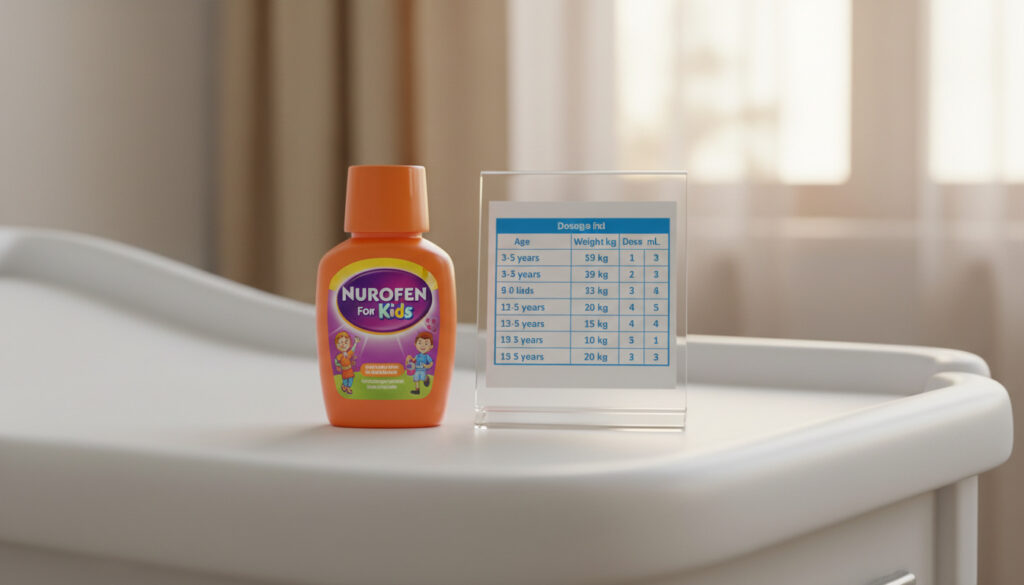
Nurofen for Kids – Dosage Guide by Age and Weight
Nurofen for Kids provides ibuprofen-based relief specifically formulated for children experiencing fever, pain, or teething discomfort. The suspension contains 100mg of ibuprofen per 5ml and carries UK approval for use in infants from three months of age, provided they weigh more than 5kg.
Precise weight-based dosing distinguishes paediatric ibuprofen administration from adult protocols. Parents must calculate doses using the child’s current weight rather than age alone, administering the medication every six to eight hours with strict adherence to maximum daily limits.
How Much Nurofen Can I Give My Child?
- Dosing calculations must prioritize body weight over chronological age
- Strict maximum of three doses within any 24-hour period for infants
- Always administer using the provided medical syringe rather than household spoons
- Administration with food or milk minimizes gastric irritation
- Total daily consumption must not exceed 40mg per kilogram of body weight
- Medical consultation required if fever persists beyond three days
- Infants under three months require explicit physician approval
| Age / Weight | Dosage (100mg/5ml) | Maximum Frequency |
|---|---|---|
| 3-6 months (over 5kg) | 2.5ml (50mg) | 3 times in 24 hours |
| 6-12 months (8-10.5kg) | 2.5ml (50mg) | 3-4 times in 24 hours |
| 1-2 years (10.5-12kg) | 5ml (100mg) | 3 times in 24 hours |
| 2-4 years (12-16kg) | 7.5ml (150mg) | 3 times in 24 hours |
| 4-6 years (16-20kg) | 10ml (200mg) | 3 times in 24 hours |
| 6-8 years (20-25kg) | 12.5ml (250mg) | 3 times in 24 hours |
| 8-10 years (25-32kg) | 15ml (300mg) | 3 times in 24 hours |
| 12+ years (40kg+) | 20ml (400mg) | 3 times in 24 hours |
Source: Nurofen UK Clinical Guidelines
What Age Can You Give Nurofen To?
Regulatory approval covers infants from three months of age weighing at least 5kg. However, medical consensus recommends consulting a paediatrician before administering ibuprofen to any child under six months, regardless of weight.
Is Nurofen Safe for Babies?
For infants between three and six months, the medication carries specific restrictions. Administration requires confirmed weight above 5kg and should only occur under medical guidance for this youngest age group. Doctors Health Fund – 2025 Eligibility Coverage Guide provides information regarding consultation coverage.
Children under three months must not receive Nurofen without specific physician direction. The immature renal function in neonates increases susceptibility to adverse effects.
Nurofen vs Calpol for Kids: Key Differences
While both medications address paediatric fever and pain, distinct pharmacological mechanisms differentiate ibuprofen from paracetamol. Nurofen acts as a non-steroidal anti-inflammatory drug, reducing prostaglandin production to address inflammation, swelling, and pain simultaneously. Calpol (paracetamol) primarily affects temperature regulation centres and pain perception without significant anti-inflammatory properties.
Duration of action varies substantially between the two. Ibuprofen typically provides relief for six to eight hours, whereas paracetamol requires re-administration every four to six hours.
Can I Give Nurofen and Calpol Together?
Alternating these medications presents a viable strategy for persistent high fevers resistant to single-agent therapy. Medical guidance suggests staggering doses, administering Nurofen followed by Calpol three hours later, while maintaining strict adherence to maximum daily doses for each medication. Paediatric combination protocols provide specific scheduling frameworks.
Side Effects of Nurofen for Kids
Gastrointestinal symptoms represent the most frequently reported adverse reactions. Stomach pain, heartburn, and nausea commonly occur, particularly when administered without food.
Always provide ibuprofen with milk or a small snack to protect gastric mucosa. This practice significantly reduces the incidence of stomach upset in paediatric patients.
Serious adverse events remain rare but demand immediate medical attention. These include allergic reactions manifesting as facial swelling or breathing difficulties, gastrointestinal bleeding indicated by blood in vomit, and renal complications. Paediatric safety resources and clinical databases document these risks extensively.
Stop administration immediately if the child develops a rash, experiences severe abdominal pain, or shows signs of breathing difficulty. Seek emergency medical evaluation without administering further doses.
Nurofen for Kids: Flavours, Forms and Where to Buy
The strawberry-flavoured oral suspension dominates the UK market, improving palatability for young children resistant to medication. Alternative formulations include topical gels for localised teething discomfort and chewable tablets for older children capable of safe mastication.
Pharmacies across the UK and EU stock these formulations without prescription. Easter School Holidays 2026 – UK, Australia, US Dates may affect pharmacy opening hours during peak illness seasons.
How Has Paediatric Ibuprofen Evolved?
- : Ibuprofen first synthesised and introduced for adult use
- Subsequent decades: Development of weight-based liquid formulations specifically for children
- Recent standards: Strawberry-flavoured suspensions establish dominance in UK markets
- Current guidelines: MHRA approves use from 3 months (over 5kg) with standardised dosing charts
Source: Clinical dosage research
What Do Guidelines Confirm vs What Requires Medical Judgment?
| Established Clinical Facts | Areas Requiring Individual Assessment |
|---|---|
| Dosing at 5-10mg/kg per administration | Long-term use beyond 3 days |
| Minimum age of 3 months (over 5kg) | Combination with specific prescription medications |
| Maximum 40mg/kg daily limit | Use in children with chronic dehydration |
| Contraindicated in chickenpox | Administration to children with complex asthma |
The uncertainty regarding specific combinations underscores the necessity of professional consultation for children with underlying health conditions. For more information on typical growth, you can refer to a child weight average chart for males at $child weight average chart male.
How Does Ibuprofen Work for Children’s Fever?
Ibuprofen functions through non-selective inhibition of cyclooxygenase enzymes, thereby blocking prostaglandin synthesis. This mechanism reduces hypothalamic temperature set-points, explaining its antipyretic effects. Simultaneously, the decreased prostaglandin production at peripheral injury sites diminishes inflammatory responses and pain signaling.
Unlike corticosteroids, ibuprofen lacks hormonal activity, making it suitable for short-term paediatric use. Paediatric medical associations confirm this mechanism as appropriate for acute fever management in otherwise healthy children.
What Do Paediatric Experts Say?
Always dose by weight, not age—use a syringe for accuracy.
— Nest Health Clinical Guidelines
Ibuprofen is safe when directed, but too much harms kidneys/stomach.
— MedlinePlus Medical Database
Summary
Nurofen for Kids offers effective ibuprofen-based relief for children from three months of age when administered according to weight-based protocols. Strict adherence to dosing intervals, maximum daily limits, and contraindications ensures safe management of fever and pain. Parents should consult healthcare providers for infants under six months or when symptoms persist beyond three days.
What flavour is Nurofen for kids?
Strawberry remains the standard flavour for UK Nurofen for Kids oral suspensions, though availability may vary by region and specific product formulation.
Where can I buy Nurofen for kids?
Pharmacies throughout the UK and EU stock Nurofen for Kids without prescription requirement. Major retailers and supermarket pharmacies typically maintain consistent supplies.
How does Nurofen work for children’s fever?
The active ingredient ibuprofen inhibits prostaglandin production in the hypothalamus, effectively lowering the body’s temperature set-point and reducing fever.
Can I use Nurofen for teething pain?
Yes, the anti-inflammatory properties specifically address gum swelling and discomfort associated with teething in children over three months.
What should I do if my child vomits after taking Nurofen?
Do not administer a replacement dose immediately. Wait until the next scheduled dosing interval and consult a pharmacist or GP if vomiting persists.
Is Nurofen suitable for children with asthma?
Exercise caution. Ibuprofen may trigger bronchospasm in children with asthma. Consult a paediatrician before administration if your child has respiratory conditions.
How should I store Nurofen for Kids?
Store the suspension at room temperature away from direct sunlight. Shake the bottle well before each use to ensure proper concentration.
More related posts
 What to Do in Adelaide: 3-Day Itinerary for the 20-Minute City
 Jake Sully: Human, Na’vi, Toruk Makto – Full Character Guide
 Vera Farmiga: Ethnicity, Religion, Family, and Languages
 Lows Adventure 3 Walkthrough: All Levels and Final Boss
 Ji Chang-Wook: Age, Height, Marriage, Career Facts
 Huda Beauty: Owner, Origins, Products & More
 Jeremy Irons: Biography, Relationships, and Controversies
 Sky News Australia – Latest Headlines and Insights